B2B Buyer Behavior: Buyers Ask AI First, Then They Ask You
67% of B2B buyers would rather skip the rep, yet 69% turn to reps to check what AI told them. How buying changed, and what it asks of every sales call.
B2B buyer behavior has shifted in one clear direction: buyers do the work on their own first. HubSpot’s 2024 Sales Trends Report found that 96% of prospects research before talking to a sales rep, and 71% would rather do their own research than talk to a rep at all. More and more of that research now runs through AI tools. The result is fewer sales conversations, and higher stakes in each one.
That does not make the rep less important. It changes the job. The buyer who finally agrees to a call already has a shortlist, a price range and an answer from a chatbot. What they want from you is judgment.
A grid of 100 dots, one per prospect. 96 are gold: 96 percent of prospects do their own research before talking to a sales rep. The dots then regroup into 71 gold and 29 pale: 71 percent would rather do their own research than talk to a rep at all.
What is B2B buyer behavior today?
B2B buyer behavior is the way business buyers find, judge and choose what to buy. Today it starts alone, on a screen. Buyers read reviews, compare pricing pages, ask peers and ask AI, often weeks before a seller hears their name. When they do reach out, they arrive with a view already formed.
The scale of that independent work is easy to underestimate. Gartner’s May 2026 survey of 645 B2B buyers found they used an average of seven information sources during a recent purchase. The sales rep is one of seven, and usually not the first.
It is also a group decision. Forrester’s State of Business Buying, 2024 found that 13 people are involved in the average buying decision, and 89% of purchases involve two or more departments. Each of those people is doing their own reading. This is why sales call preparation has stopped being optional: you are walking into a room that has already done its homework.
Why do most B2B buyers want a rep-free experience?
Most buyers want to move at their own pace, on their own terms. In a March 2026 survey of 646 B2B buyers, Gartner found 67% prefer a rep-free experience. A year earlier, in its June 2025 release, the figure was 61%.
A flow of all B2B buyers splits into two bands. In 2025 the gold band, buyers who prefer a rep-free experience, is 61 percent. The bands then shift to 2026, when the gold band grows to 67 percent.
Source: Gartner, sales surveys of B2B buyers (2025 and 2026). 2025 figure from Gartner's June 2025 release
A rep-free experience means a buyer can learn, compare and often buy without a salesperson in the loop. It is easy to read that as rejection. It is better read as a complaint about wasted time. The same 2025 Gartner release found that 73% of B2B buyers actively avoid suppliers who send irrelevant outreach.
Buyers are not avoiding help. They are avoiding the generic pitch, the discovery call that asks what the website already answered, and the demo that ignores what they said last week. Gartner’s analyst Alyssa Cruz put the balance well: sellers “must remain helpful while keeping the experience low-friction.”
Buyers are not avoiding help. They are avoiding the call that wastes their time.
How is AI changing B2B buying behavior?
AI is becoming the first stop. In Gartner’s 2026 survey, 45% of B2B buyers said they used GenAI during a recent purchase, mainly to gather information on vendors and products. Forrester found that almost 95% of buyers expect to use GenAI to support a purchase decision within a year. The question a buyer used to bring to a rep now often goes to a chatbot first.
But buyers do not fully trust what comes back. Gartner found 51% say they are more likely to run into misleading information from GenAI. So they go looking for a second opinion.
A chat window with an AI assistant: 45 percent of B2B buyers used generative AI during a recent purchase. The window then becomes a conversation with a sales rep, where the buyer checks what the AI said: 69 percent of B2B buyers prefer to validate AI-generated insights with a sales rep.
That second opinion is you. Gartner found 69% of B2B buyers prefer to validate AI-generated insights with sales reps. As Gartner’s Robert Blaisdell said, buyers “still turn to sales reps to validate AI-generated insights, and support decision-making at critical moments in the journey.”
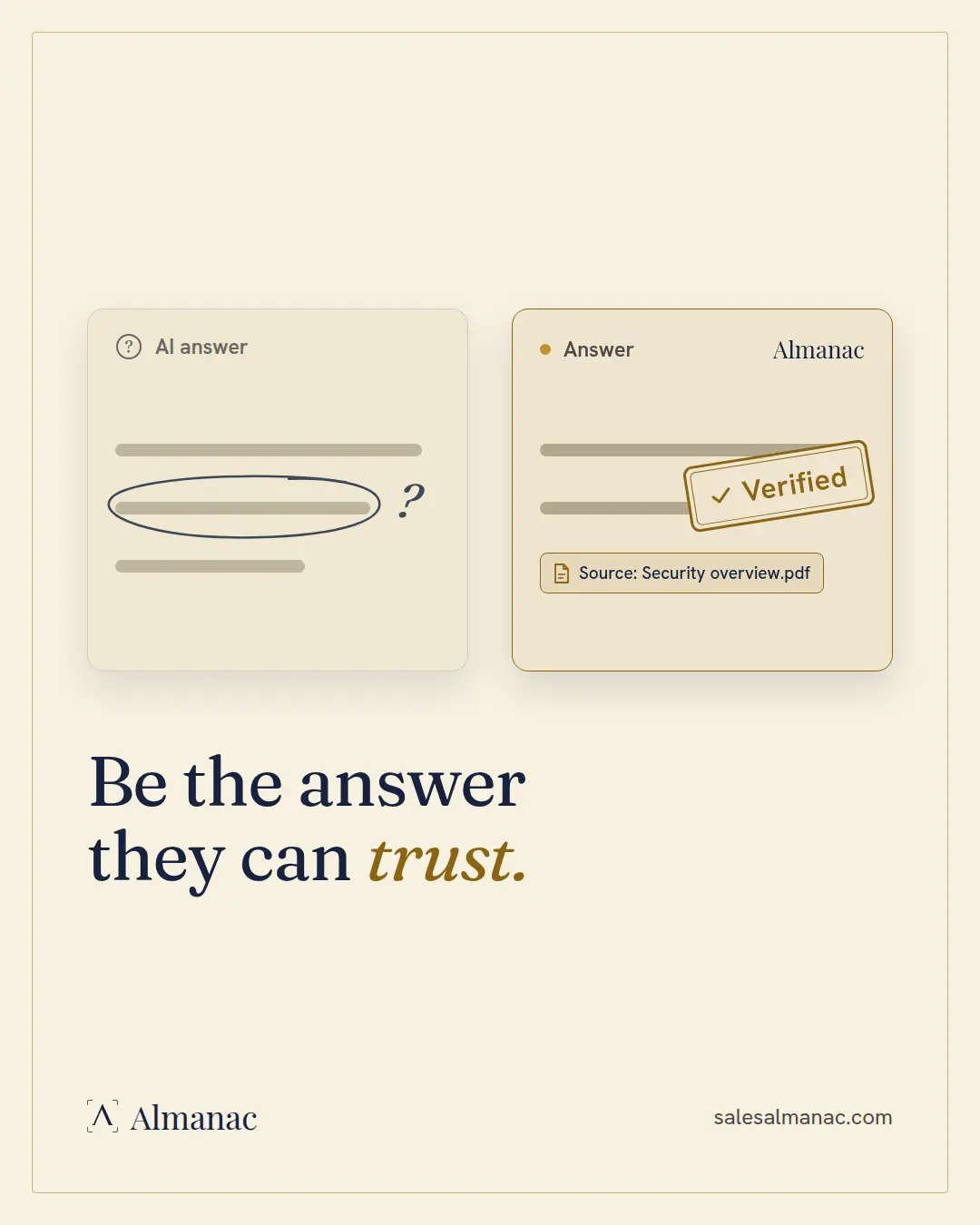
This is the real shift in the rep’s role. You are no longer the main source of information. You are the check on it. The buyer arrives with a summary of your product, your competitors and your pricing that may be half right. Your job is to know which half.
Where do sales reps still matter most?
Reps matter most where the general answer stops and the buyer’s own situation begins. Gartner’s 2025 research found that for tasks that need context, “such as determining whether a product or service fits their company’s needs, buyers prefer to seek seller input.” A chatbot can describe a product. It cannot tell a buyer how it will work inside their company.
That is also where deals are won or lost. Forrester found 86% of B2B purchases stall during the buying process. Gartner’s 2026 research found that buyers who feel confident in their decision are twice as likely to report a high-quality deal. Confidence is what a good rep adds. Not more facts, but a clear read on which facts matter for this buyer.
The bar for earning that role is high, and it has been for years. LinkedIn’s 2018 State of Sales report found that 77% of decision makers won’t engage with salespeople who don’t have insights or knowledge of their business. Add AI to the mix and that bar only rises. A buyer who has already asked a chatbot will notice quickly if you know less than it does.
What should reps do differently before and during the call?
Reps should treat every call as a review of what the buyer already believes. Arrive knowing their business, expect them to have done their research, and be ready to confirm, correct or deepen it. Four habits help.
- Research the buyer the way they researched you. Read their site, their news and their people. Our checklist on what to research before a sales call covers the essentials.
- Ask what they have already found. “What have you read so far, and what are you still unsure about?” respects their work and shows you where the gaps are. Often it surfaces what an AI tool told them.
- Correct with care, and with proof. If the buyer has a wrong price or a wrong feature, say so plainly and show the source. You are earning trust, not winning a point.
- Speak to the whole buying group. With 13 people in the average decision, the person on the call is rarely the only one reading. Stakeholder mapping helps you know who else needs an answer.
When a question comes up that you cannot answer on the spot, do not guess. A confident wrong answer is exactly what buyers came to you to avoid. Here is what to do when you don’t know the answer.
Where Almanac fits
Almanac is built for the calls that now carry this much weight. Before a call, it prepares a short brief, so the rep arrives informed. During the call, it puts answers from your team’s playbook on the rep’s screen, visible only to the rep, so when a buyer repeats something an AI told them, the rep can confirm or correct it with the right answer. Your playbook is built from the PDFs, docs and URLs you upload, and an update reaches every rep on their next call.
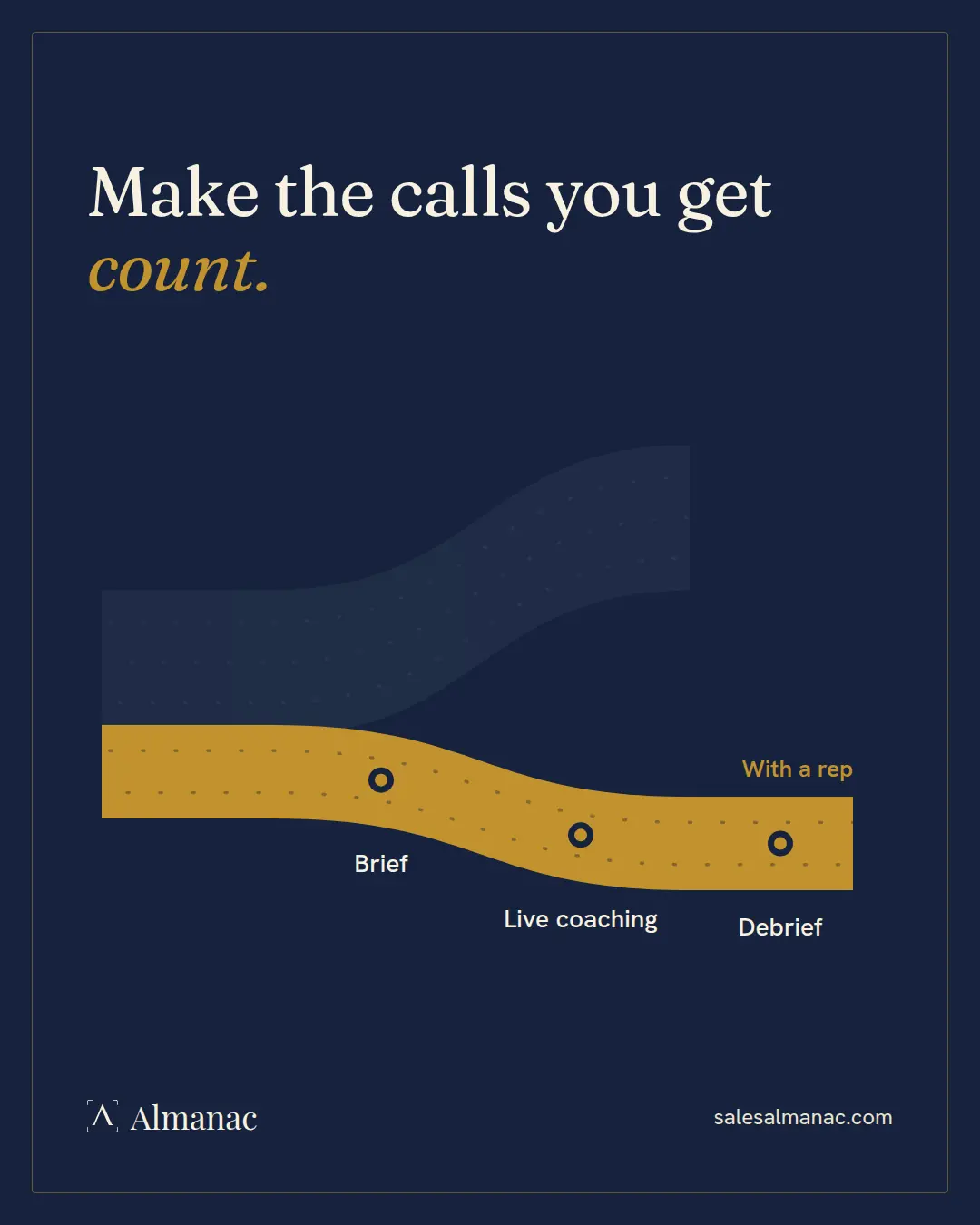
Reps can rehearse with Trainer, an AI buyer built from your personas and objection library, before the stakes are real. After the call, Almanac writes a scored debrief and drafts the follow-up email.
Frequently asked questions
What are the biggest trends in B2B buyer behavior?
Buyers research on their own first, often with AI, and involve more people in each decision. Gartner found 67% of B2B buyers prefer a rep-free experience, and 45% used GenAI during a recent purchase. Yet 69% still prefer to validate AI-generated insights with a sales rep.
What is a rep-free buying experience?
It is a buying process a customer can complete without talking to a salesperson, using websites, reviews, peers, AI tools and self-service purchasing. Gartner found 67% of B2B buyers preferred one in 2026, up from 61% in its 2025 release.
Do B2B buyers still want to talk to sales reps?
Yes, but later and for a different reason. Buyers prefer to seek seller input on whether a product fits their company, and 69% prefer to validate AI-generated insights with a rep. They want judgment and context, not a recital of the website.
How much research do B2B buyers do before contacting sales?
A lot. HubSpot found 96% of prospects research before talking to a rep, and Gartner found buyers use an average of seven information sources during a purchase. Many now begin with an AI tool.