The B2B Buying Committee: Who Really Decides, and Why Deals Stall
The average B2B buying committee now has 13 people across several departments. Who sits on it, why it stalls, and how to sell to the whole group.
A B2B buying committee is the group of people inside a company who decide together whether to buy, and from whom. It is bigger than most sellers assume. Forrester’s State of Business Buying 2024 found that 13 people take part in the average buying decision, and that 89% of purchases involve two or more departments. Gartner puts the range at five to 16 people across as many as four functions.
Most reps talk to one of them. The others decide anyway, in meetings the rep never sees, with information the rep never gave them. That is why knowing the committee is the first job of good sales call preparation, not a task for the proposal stage.
A seller is connected to a single contact, who sits in a network of 13 people: the average number involved in a B2B buying decision. Four of those people then light up, labeled finance, IT, security and legal, each with a new line back to the seller, under the question: who else should join the next call?
Who sits on a B2B buying committee?
A typical B2B buying committee includes the person who owns the problem, the person who owns the budget, the people who will use what you sell, and the people who can stop it: IT, security, legal and procurement. On larger deals, a senior sponsor joins them. Titles change from company to company. The roles do not.
It helps to think in jobs rather than job titles.
- The person with the problem. Usually your first contact. They feel the pain most, and they often become your champion.
- The budget owner. They approve the spend, and they weigh it against every other way the money could be used, not just against other vendors.
- The people who will use it. Their working day changes if the deal goes through. They want to know whether it works in practice.
- The checkers. IT, security, legal and procurement. They rarely start a purchase. They can end one.
- The sponsor. On big deals, a senior leader decides whether the purchase fits this year’s priorities at all.
One person can play two of these roles. On a large deal, three people may share one. Our guide to stakeholder mapping in sales shows how to chart each of them before you dial in. This piece is about something else: why the committee behaves the way it does, and what that asks of the seller.
Why buying committees keep getting bigger
Committees grow because purchases now touch more of the business. A new tool connects to other systems, so IT gets a vote. It holds company data, so security and legal get one too. It costs money in a careful year, so finance looks harder. Forrester names tight budgets and long purchase cycles among the forces making B2B buying harder today.
The cost of a bigger committee shows up as delay. Forrester found that 86% of B2B purchases stall during the buying process. Every extra person adds a calendar, a set of questions and another reason for the deal to wait a week.
But size alone does not sink deals. Plenty of large groups buy quickly. What slows them down is what happens between the people.
The real risk is not size. It is disagreement.
In a survey of 632 B2B buyers, Gartner found that 74% of buyer teams show “unhealthy conflict” during the decision. It describes that as members with conflicting goals, members who disagree on the best course of action, or a group that gets overruled by decision makers outside it.
Agreement, by contrast, pays. The same survey found that buying groups that reach consensus are 2.5 times more likely to report that their deal was high quality.
Six members of a buying group, from finance, IT, legal, users, operations and the executive team, sit far apart and point in different directions: 74 percent of B2B buyer teams show unhealthy conflict during the decision. They then move in around one shared decision and all point at it: groups that reach consensus are 2.5 times more likely to report a high-quality deal.
Source: Gartner, survey of 632 B2B buyers (2025). Conducted August to September 2024
That changes what a seller is for. A rep who wins over one enthusiastic contact has not won the deal. They have won one vote, in a group that may be pulling in five directions. The finance lead wants a short payback. IT wants nothing new to maintain. The users want the old way to stop hurting. Each is right, and none of them has heard the others say it out loud.
The job is not to win one champion. It is to help a room of busy people agree.
Why your champion can’t carry the deal alone
Your contact may believe in you completely. They still have to sell you to people who were not on the call, who have their own priorities, and who will hear about you secondhand. Most champions have never been asked to do that. They also have a day job.
Gartner’s research points to what helps. Messages built around what the group shares improve consensus by 20%. Messages tuned only to one person’s interests can do the opposite and create conflict inside the group. And when buyers find a seller’s content relevant to the whole group, they are three times more likely to report a high-quality deal.
So the most useful thing you can give a champion is something they can forward without rewriting. One page. The shared problem in the buyer’s own words. What it costs to leave it alone. And the question each function will ask, with a short answer.
How do you sell to the whole buying committee?
You sell to a buying committee by finding its members early, bringing them into the conversation on purpose, and giving them one shared story to agree on. Five habits do most of the work.
- Ask about the decision, not just the need. On the first call, ask how the company bought something similar last time, who was involved and where it slowed down. People answer that question honestly, and the answer is a map.
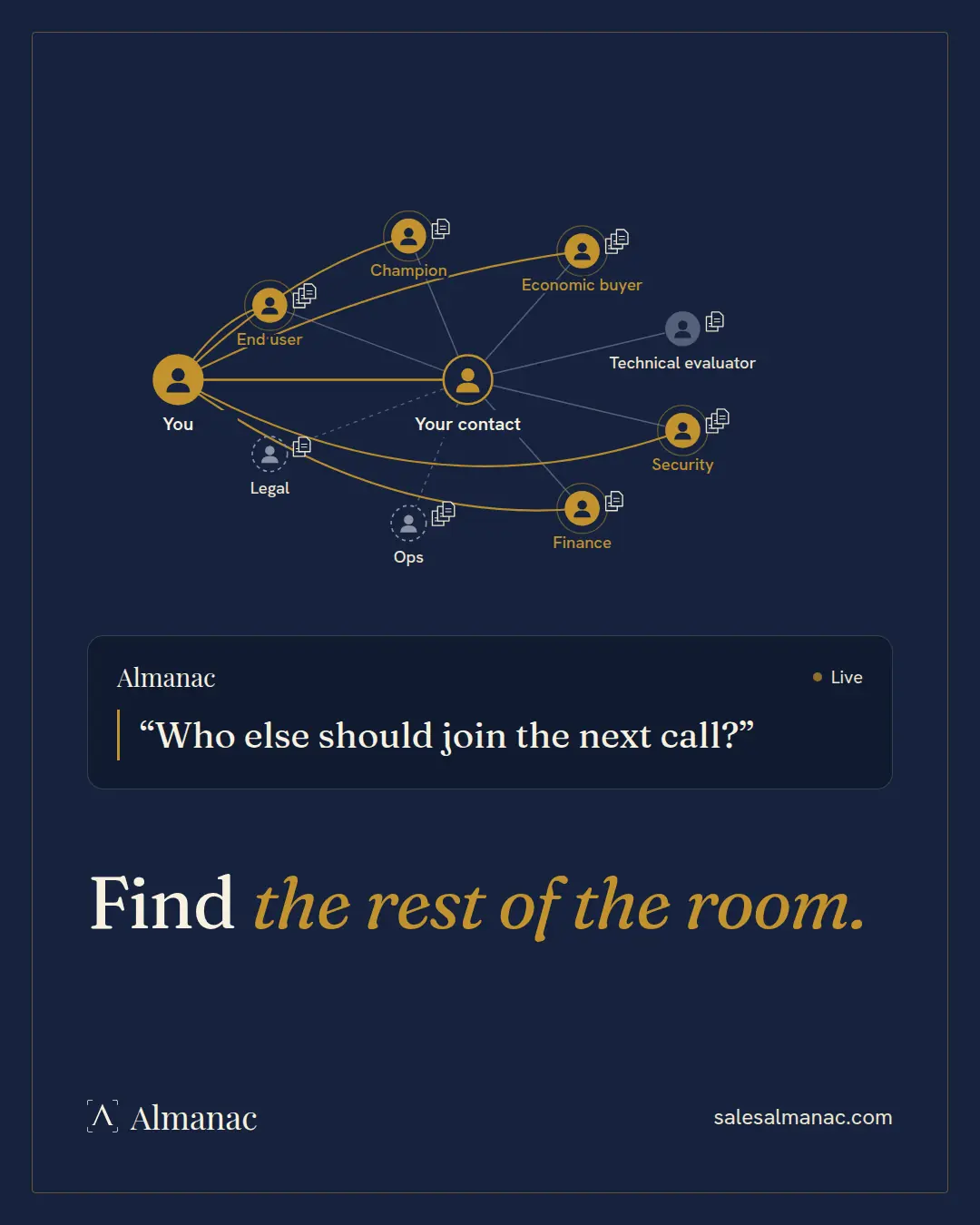
- Ask who else should join the next call. Then ask why. The answer tells you who cares, and what they care about.
- Bring the checkers in early. A security or legal question answered in week two costs an afternoon. The same question found in week ten can cost a quarter.
- Write for the group. Recaps, proposals and business cases should lead with the shared problem, then cover what each function needs. One document the whole committee can read beats five that pull apart.
- Prepare for each person before each call. Know who is joining, what they have already heard and what they still need. Our checklist of what to research before a sales call covers the basics.
None of this is new advice. What is new is the size of the room. With 13 people in the average decision, the deal is decided in the conversations you are not in. Your job is to make the ones you are in travel.
Where Almanac fits
Almanac helps reps keep the whole committee in view. Before a call, it builds a brief: what is already captured about the deal, what is still missing, and who in the room already has the story. During the call, it puts live answers and the next question from your team’s playbook on the rep’s screen, visible only to the rep, so a hard question from a new face does not stall the meeting.
After the call, Almanac writes a scored debrief, drafts the follow-up email and prepares handoff docs, so the recap reaches the rest of the committee while the conversation is fresh. And in the Trainer, reps can role-play against a live AI buyer built from your team’s personas and objection library, including the skeptical finance lead they have not met yet.
Frequently asked questions
What is a B2B buying committee?
A B2B buying committee is the group of people inside a business who share a purchase decision. It usually includes the person with the problem, the budget owner, the people who will use the product and functions such as IT, security, legal and procurement.
How many people are on a B2B buying committee?
Forrester’s State of Business Buying 2024 found that 13 people take part in the average B2B buying decision, and 89% of purchases involve two or more departments. Gartner’s 2025 research puts the range at five to 16 people across as many as four functions.
What are the main buying committee roles?
The core roles are the person with the problem (often the champion), the budget owner, the end users, the checkers in IT, security, legal and procurement, and, on larger deals, an executive sponsor. One person can hold more than one role.
Why do buying committees slow deals down?
More people means more priorities to reconcile. Gartner found that 74% of B2B buyer teams show unhealthy conflict during the decision, and Forrester found that 86% of purchases stall along the way. Groups that reach consensus are 2.5 times more likely to report a high-quality deal.